Founders Spotlight: Huskeys Re-architecting the Network Edge for the AI Era
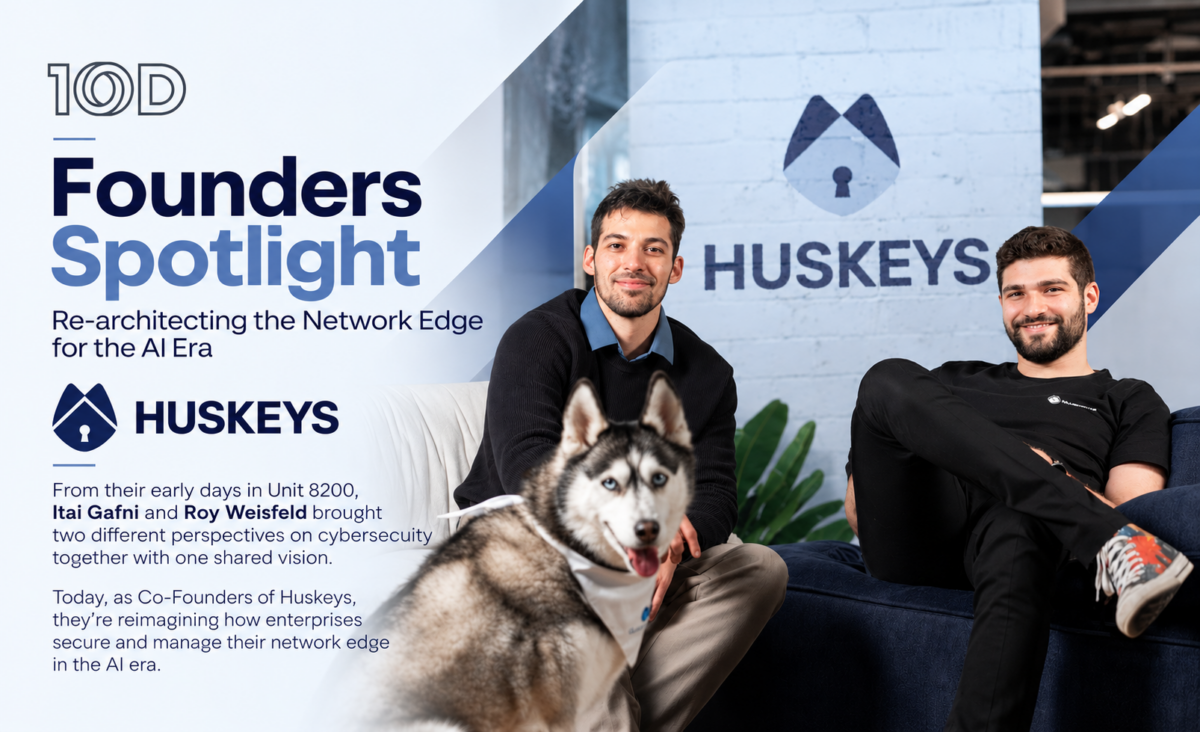
Re-architecting the Network Edge for the AI Era
When Itai Gafni and Roy Weisfeld were in Unit 8200, their worlds revolved around the exact same digital perimeter, though they viewed it from entirely different angles.
Roy spent his nights staring at cloud architectures and CDN environments, probing for the micro-vulnerabilities that only show up when internet traffic hits critical mass. He was fascinated by how brittle web security actually was-how easily expensive defensive setups folded the moment a real-world, high-traffic attack hit them.
A few desks away, Itai was obsessed with a different problem: how to make sense of the overwhelming noise inside cyber operations. As his department’s AI lead, he saw how human analysts were drowning in operational alerts, constantly trying to piece together fragmented signals.
When Itai went on to co-found a monitoring and observability startup, he spent countless hours in the trenches with enterprise engineering teams running internet-scale applications. Over endless debugging sessions with weary CISOs, he saw a recurring frustration: security teams weren’t failing because they lacked tools. They were failing because their tools operated in total isolation, forcing them to constantly choose between locking down the system or letting actual revenue flow through.
Roy, meanwhile, was continuing to break into web applications as an offensive security researcher, watching from the outside as those same security teams kept setting up static, predictable rules that were trivial to bypass.
The two had been living on opposite sides of the exact same broken system. When they reconnected over coffee in Tel Aviv in early 2025, they realized neither of them could let the problem go.
The Unspoken Trade-Off
Every founder has a moment where an industry flaw stops being a minor nuisance and turns into an obsession. For Itai and Roy, it was watching the impossible position enterprise security teams were put in every single day.
The industry had quietly accepted a dirty secret: Web Application Firewalls, built three decades ago for static web pages, routinely blocked real, paying customers. To fix it, engineers were forced into endless manual rule tweaking in a desperate bid to clear false positives – only to open up new security holes in the process.
Worse, legacy security vendors were telling these companies that the only way forward was a painful, multi-million-dollar “rip and replace” of their entire edge stack.
Then came the shift that made the status quo completely untenable. Attackers began leveraging AI to discover and exploit vulnerabilities in real time, while legitimate autonomous AI agents started flooding the web, accounting for a massive share of traffic. A 30-year-old security model designed for humans clicking links was suddenly completely blind.
Itai and Roy knew that adding another point solution to an already bloated stack was a dead end. Instead of asking companies to throw away the CDNs and WAFs they had spent years configuring, they asked a different question: What if an intelligent, autonomous layer could sit on top of everything they already owned and make it act as one?
A Quiet Revelation on the Edge
Building Huskeys wasn’t just about writing smarter algorithms; it was about shifting how companies measure security.
In their earliest days, while working closely with a high-volume enterprise customer, the team ran into a classic edge nightmare: legitimate buyers were silently getting blocked at checkout because traditional WAF rules flagged their traffic patterns as suspicious.
Instead of waiting for an engineer to manually rewrite rules, Huskeys’ agentic layer analyzed the context in real time, cleared the false positives, and allowed the purchases through. Within a few hours, the platform had restored millions of dollars in blocked revenue.
For Itai and Roy, that wasn’t just a technical win. It was the moment their core thesis was proven in the wild: edge security wasn’t an IT tax or a compliance checkbox: it was a direct revenue driver.
Building for the Next Era
What keeps Itai and Roy energized as Huskeys grows isn’t just solving today’s WAF headaches – it’s preparing for the fundamental shift happening across the open web.
Over the next few years, autonomous AI agents will become the primary consumers and generators of web traffic. The traditional boundaries between human browsers, bots, and APIs are disappearing entirely. Managing that transition requires an entirely new control plane – one built from the ground up to understand context, adapt in milliseconds, and keep the edge working for the business rather than against it.
For two founders who started out on opposite sides of the cybersecurity fence, rebuilding that thirty-year-old foundation is the challenge of a lifetime.