Founders Spotlight: Zorro – Closing the Affordability Gap
Closing the Affordability Gap
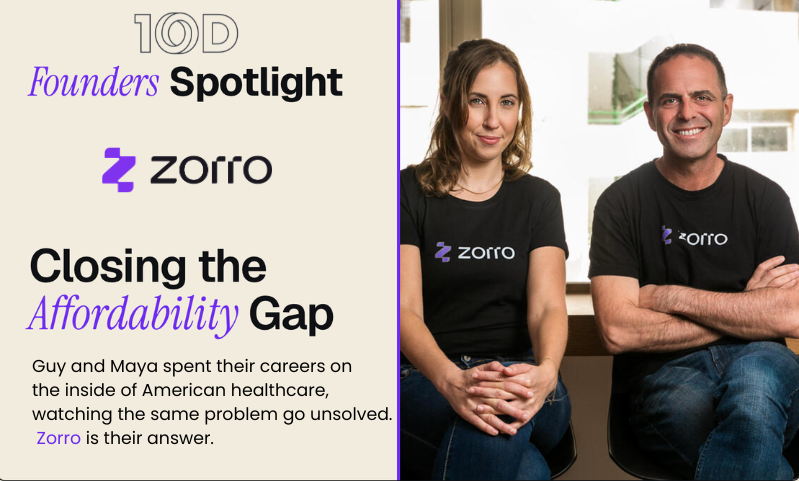
Guy and Maya spent their careers on the inside of American healthcare, watching the same problem go unsolved. Zorro is their answer.
As a young adult, Maya was in a serious car accident. When the hospitalization was over, she was handed a bill for $100,000.
She wasn’t a consultant yet. She wasn’t a researcher or a venture investor. She was a patient holding a number she had no way of reconciling with reality. A few years later, during the 2008 financial crisis, she watched family members lose their jobs and, in the same moment, lose their health coverage. In the United States, the two are tied together in a way they aren’t almost anywhere else in the world.
Those two experiences became the quiet argument that shaped the rest of her career. Maya went to PwC, then McKinsey, which gave her a front-row seat to how the business of healthcare actually works. She did research at Harvard and MIT on the intersection of policy and industry. She worked at digital health startups, pulled by the idea that technology could close the gap she had felt personally as a 20-something opening a hospital bill.
By the time she joined Pitango, one of Israel’s largest venture capital funds, as a Principal on the HealthTech team, Maya had a thesis that sounded almost too simple to be interesting. The biggest problem in American healthcare isn’t that the medicine doesn’t work. It’s that people can’t afford to get to the medicine.
Guy had arrived at the same thesis from the opposite direction.
For more than 25 years, he built medical device companies. He led teams at Medtronic and Bayer. He founded startups. Every company he built was organized around a specific patient segment and a specific clinical problem — a heart valve to replace, a procedure to enable, a condition to treat. Important work, and he loved doing it.
Then Guy became Managing Partner at Pitango. For the first time in two and a half decades he wasn’t in the weeds of a single product. He was looking at the entire healthcare landscape from 30,000 feet, and the view from up there told him a different story than the one he had been living on the ground.
In America, the significant majority of people aren’t worried about a heart valve or a specialized surgical procedure. They’re worried about whether they can afford to take their kid to the doctor or fill a prescription.
The biggest problem wasn’t clinical. It was economic. People couldn’t afford the care, regardless of how sophisticated the concept.
Guy and Maya met at Pitango. They liked their jobs. And both of them were, quietly, restless with it.
They wanted to be back in the founder’s arena. Not advising. Not evaluating. Building. They started meeting to talk about what was really wrong with American healthcare, and the longer they talked, the clearer it got that the gap they were both drawn to, between what care costs and what people can afford, was not going to be solved by any of the companies they were evaluating as investors. It was going to have to be solved by someone willing to attack the foundation. The way that about 50% of Americans gain access to health insurance: their employer.
In early 2022 they left Pitango and started Zorro.
The first thing that strikes anyone who studies American health benefits is that the brokenness is not a secret. Employers know. Employees know. Brokers know. The industry has been quietly accepting for decades that this is simply how health insurance has to work in the United States.
It doesn’t. The United States is the only country in the world that places the cost and selection of health plans on employers, and Americans have come to accept that arrangement. Most U.S. companies end up picking one carrier, with maybe three plans, for a workforce that can span hundreds or thousands of people with completely different lives. A 30-year-old who has never seen a doctor outside an annual physical gets the same options as a 55-year-old managing a chronic condition. It would be easier to justify if it was cost effective, but for most employers, that’s far from the case. Employers face unpredictable annual rate hikes they can’t control. Employees get whatever their company picks, whether it fits their budget or not. Brokers sit in the middle, trying to make an impossible arrangement work for everyone at once.
Guy and Maya’s conviction is that the premise itself is wrong. One-size-fits-all coverage, delivered through the employer, is a model built for administrative convenience, not for the person using it.
What they saw in ICHRA, the Individual Coverage Health Reimbursement Arrangement, was the ultimate game changer. A model in which the employer sets a predictable budget instead of continually fighting a rate hike. The employee chooses coverage that actually fits their needs. The broker delivers a viable solution instead of managing the fallout of a bad system. ICHRA had existed in regulation for years. What was missing was the software, the AI, the decision support and the customer experience to make it work at scale. That is what Zorro was built to be.
Guy and Maya share a belief most people in their industry would push back on: deep expertise can sometimes be a liability.
The conventional wisdom says you need to understand an industry inside out before you start a company in it. They agree you have to learn quickly. What they push back on is the idea that you have to know everything first. Watching founders succeed and watching founders fail, the ones who made it were usually the ones who had just enough ignorance to believe the impossible was doable. They didn’t know how hard it would be, so they kept going. By the time reality set in, they were already too far in to turn back.
People have told Guy and Maya, repeatedly, that employer-sponsored benefits are too complex to change. Too entrenched. Too tangled with regulation, incumbents and inertia. They don’t think so. And that belief, grounded in optimism and a healthy dose of naïveté, is what keeps them moving when the industry tells them the system can’t be rebuilt.
The milestone the two of them are chasing right now isn’t a funding round or a user number. It’s a feeling.
They are pushing toward the day an employer engages Zorro for the first time and finds a benefits experience built for the business they actually run, not a generic catalog designed for someone else. They are pushing toward the day an employee logs in and realizes the coverage on the screen was recommended based on their priorities, their budget and their family situation, not chosen for them by someone at their company. They are pushing toward the day a broker opens the platform and, for the first time in years, feels the tool makes it easier for them to provide excellent support for their clients.
Most of what the Zorro team does every day is in service of that. Sharper AI to help guide employees through their plan choices and tradeoffs, based on their unique needs and priorities. Better tools for brokers who have been living inside spreadsheets. Deeper support for HR leaders and benefits administrators who want to ensure they can remain compliant while getting the best value for their investment. Growth, yes, but growth as a way of getting more people into a model that works, not as a milestone in itself.
The health insurance market keeps throwing curveballs. Rate hikes. Policy uncertainty. The discipline, for Guy and Maya, is staying laser focused on the thing they set out to do from day one. Equitable, affordable access to healthcare coverage. For anyone who has ever been handed a bill and found a number they couldn’t make sense of.