
Israeli Physical AI Map
Israel Built the Stack. The Applications Are Only Getting Started.
Israel has spent roughly fifty years building the foundation that autonomous systems run on. It began with communications and chips, where Galileo and Chromatis became landmark exits and Mellanox grew into the interconnect behind today’s AI data centers. That hardware depth moved into sensing and computer vision, where PrimeSense brought 3D sensing to Apple’s devices and Mobileye made automotive perception a global standard. The same lineage now drives autonomous defense, where XTEND and D-Fend field systems sense and act on their own. Today in Israel, the Physical AI sector spans 125 companies that have raised over $10 billion in venture capital, with 8 unicorns and 23 exits among them. When we mapped these companies, one pattern stood out: the foundation is decades deep, but the market built on top of it is still just getting started. The application layer, especially outside defense, is still early and fragmented across mobility, healthcare, agriculture, and industrial areas, with dozens of companies already at work and room for many more.
- A base built over fifty years, from 1970s communications and chips to today’s sensors and computer vision. Israel ranks #1 in R&D as a share of GDP, close to 7%, more than twice the OECD average (OECD)
- A deep track record across sensing, autonomous systems, defense, and mobility, from Innoviz to Mobileye, D-Fend, and HevenDrones. On this map alone: 8 unicorns and 23 exits
- Israel owns perception: a world-class enabling layer of more than 60 computer vision companies, over 2,300 patents, and edge inference at single-digit watts, among the largest such concentrations outside the US and China (IIA, 2026)
- Value is migrating from training the biggest model to deploying it. From 2025 onward, the edge sits in system-level AI, where domain expertise and system design decide who wins (IIA, 2026)
- The application layer is where the expansion opportunity is: dozens of companies are already active across mobility, healthcare, agriculture, and industrial. However, the application layer is still fragmented and in early stages of deployment
What is Physical AI?
Physical AI begins where artificial intelligence meets the physical world. The figure below builds it from three capabilities. AI and machine learning supplies the models that learn and decide. Sensors and actuators supply perception, signal processing, and the motion and control that act on the world. World modeling supplies the 3D environments, simulation, and digital twins a system reasons over. Physical AI sits where the first two meet: AI joined to sensors and actuators, perceiving and analyzing the world around it. Where all three meet, at the center, you get an autonomous system, one that also acts on what it senses.
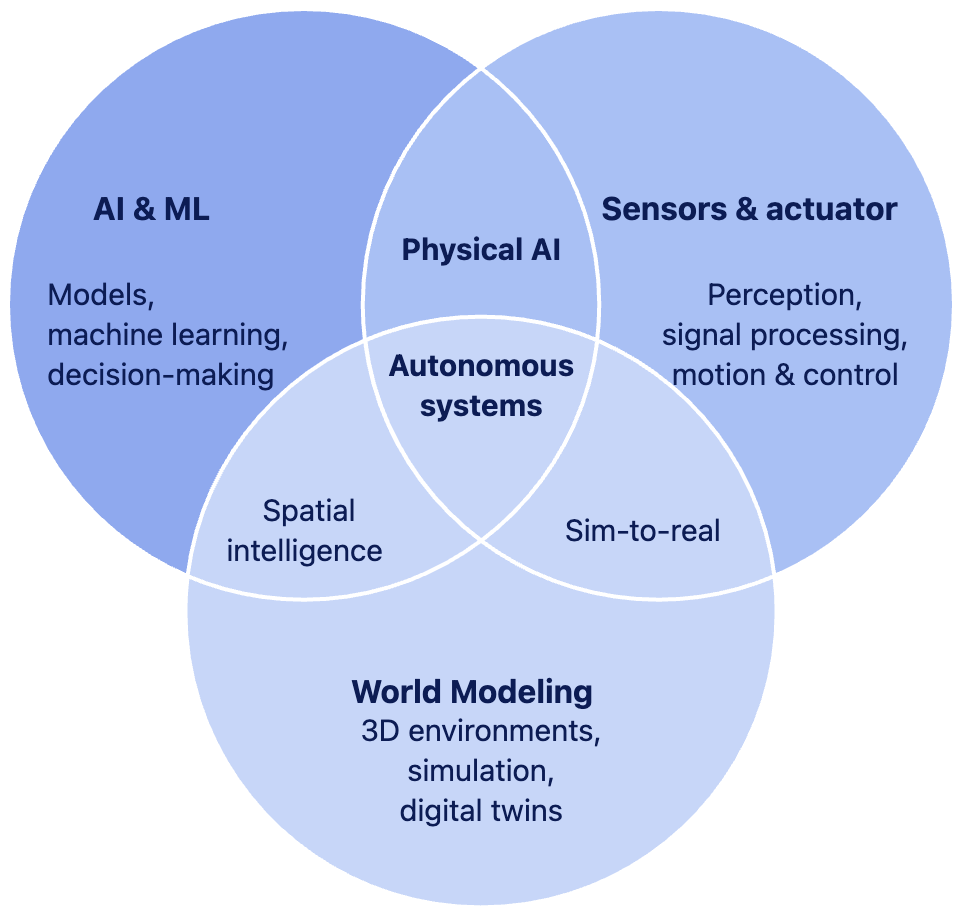
Based on: Israel Innovation Authority, AI Strategy Report, April 2026
The map below tracks the physical AI companies building in Israel today. Most of them stop at perception: they sense the world and hand the result to another system to act on. That is the enabling layer, where Israel is most experienced. Fewer companies close the loop, deciding, and acting on their own. That is the autonomous layer, harder to build and shorter on names.
Where Israel leads
Israel’s lead shows up first as a deep enabling base. More than 60 computer vision companies hold over 2,300 patents between them, among the largest such concentrations outside the US and China (IIA, 2026). Edge inference now runs at single-digit watts. The country also ranks #1 in R&D as a share of GDP, close to 7%, more than twice the OECD average (OECD). None of that is new, and none of it is an accident: three forces built it over roughly fifty years, and only one of them is unique to Israel.
The military pipeline
Talpiot, Unit 81, Rafael, IAI, Elbit, and ELTA run some of the most demanding physical sensing programs in the world: radar, electro-optics, signal intelligence, precision guidance. What makes these programs unusual is not just their technical difficulty but their timeline. Talpiot recruits engineers before age 18 and puts them through years of applied R&D under real operational constraints. By the time a Talpiot engineer enters the private sector, they’ve already solved hard physical problems at scale, problems that have no civilian equivalent for engineers coming straight out of university.
The result is a founder base with an unusually early start, one that has learned the distance between a lab and the field, and builds for the field from day one. No other ecosystem produces quite the same engineers, and this is the one advantage that is genuinely hard to copy.
Academia ↔ Industry
Universities spinning out companies is not unique to Israel; Stanford and MIT do the same. What is unusual here is the soil those labs grow in, a research base fed by engineers who came up through the military’s technology units. Mobileye and TriEye both grew out of Hebrew University labs, Mobileye from Amnon Shashua’s computer-vision research and TriEye from a decade of Uriel Levy’s nanophotonics work. Others were founded by professors who left to build, among them Mentee Robotics, started in 2022 by Shashua, Lior Wolf, and Shai Shalev-Shwartz.
The pattern holds across institutions. Technion, Tel Aviv University, Hebrew University, Weizmann, and Ben-Gurion have each produced Physical AI companies in the past decade. This academic-to-company pipeline is the main way deep research here becomes product.
The global R&D exit cycle
Global R&D centers aren’t unique to Israel in number, multinationals run them everywhere, but Israel’s centers design core components for the global product, not local variants of it. What compounds here is the loop between those centers and local founders. Intel opened its first design center outside the United States in Haifa in 1974. There, Israeli engineers designed the 8087 math co-processor and helped create the 8088 chip behind the original IBM PC. The engineers who came through Intel went on to build the companies it and others later acquired. Nvidia bought Mellanox, the Israeli interconnect maker now central to AI data centers, for nearly $7 billion, and later Run:ai. Today Nvidia runs its largest R&D presence outside the United States in Israel, and Jensen Huang has called Israel “one of the countries best positioned to lead Physical AI”.
Each acquisition reseeds the next cohort with capital, networks, and credibility, and the cycle sustains itself. In January 2026 the United States and Israel signed a Strategic Partnership on AI, the first the US has signed with any country, formalizing what the private sector had been building for years. Funding has followed: Israel raised more than $3 billion in the first quarter of 2026, up about a third on the year before (CTech, 2026). None of these forces is rare on its own. What is rare is the combination, in a country small enough for the same people to move from the army to the lab to the startup and back again.
Where the gaps and opportunities are
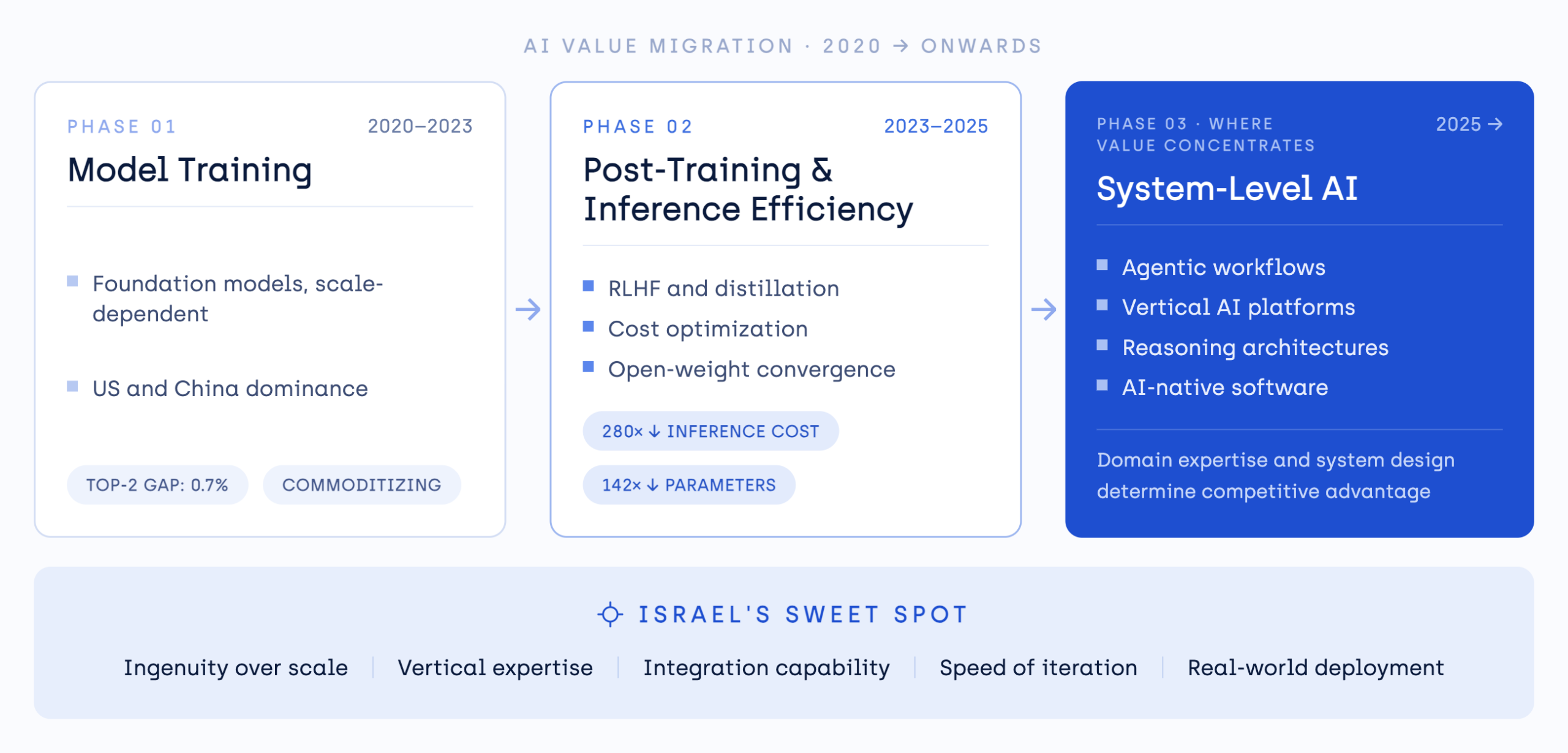
Three years ago, the race was to build the best model. The gap between the top two models on standard benchmarks was 4.9%, and training a larger model got you ahead. That gap is now 0.7%, and the models are converging. The advantage migrates to the layer above: systems that take those models into the physical world, tuned to a domain, wired to hardware, running in real conditions. The Israel Innovation Authority’s 2026 strategy calls this “system-level AI”. We think it is where the most important Physical AI companies of the next decade get built.
Israel’s strengths fit this layer: deep engineering, fast development cycles, and instincts built over decades of defense and mobility deployment. The map confirms the enabling base is dense with companies, while defense has consolidated around a handful of leaders, and civilian application companies are numerous, fragmented, and still taking shape.
Israel’s first autonomous systems came out of its universities and its automotive sector. Mobileye is the touchstone: a Hebrew University vision project that became the world’s dominant automotive-perception company and sold to Intel for more than $15 billion. That wave taught a generation of founders how to ship into the real world. Then the demand changed. From 2022, the wars in Ukraine, Gaza, Lebanon, and against Iran-linked fronts created urgent demand for autonomous defense systems, and Israeli founders had the exact background to meet it. Defense is now the single largest cluster on the map, and roughly one in three companies here carries a defense tag.
This is where the distinction matters: what a company sells doesn’t tell you what it does. Mobileye sells its perception-and-driving stack to carmakers, but the system drives the car, it acts, it doesn’t just supply a part. The real question is how many Israeli companies act in civilian markets. The delivery drone at your door. The shuttle on an urban route. The warehouse robot filling orders. The tractor working a field with no driver. These markets are real and growing, and Israel’s civilian operators are spread across all of them, early and fragmented, with no consolidation yet.
The data and vertical-depth opportunity
As foundation models converge, the advantage moves elsewhere. The sim-to-real gap is closing fast, and ABB and Nvidia reported largely solve it for industrial robotics in 2026. The edge now shifts to two things models alone do not supply. The first is data: large-scale, real-world and simulated, collected and curated through purpose-built infrastructure. A deployed system generates its own training data, which builds a flywheel where better models drive more deployment and more deployment yields better data (a16z, 2026). The second is vertical depth, knowing a domain and its hardware well enough to make a system work in the field.
Israel’s enabling base is the raw material for both. The sensing, the chips, the computer vision, the signal processing: the same depth that makes Israel strong in components is what the missing civilian operators can be built from. That is the bet. The companies that turn perception into action, including in civilian markets, are the ones worth building and backing now.
Full Company Directory
All 125 companies across both layers. Featured companies appear in the map above. Tap any section, sub-category, or company row to expand it.
Application
Defense – Autonomous Systems (24)
Aeronautics (Aeronautics Group) Exit · Defense – Autonomous Systems
Aeronautics, acquired by Rafael Advanced Defense Systems in 2019, designs, manufactures, and supports unmanned aerial systems, loitering munitions, and ISTAR and electro-optical payloads for defense, homeland-security, and border-surveillance customers worldwide.
Airobotics Exit · Defense – Autonomous Systems
Airobotics, acquired by Ondas Holdings in January 2023, builds autonomous drone-in-a-box systems for industrial site inspection and monitoring, alongside counter-drone interception systems for critical infrastructure, defense, and homeland-security customers.
Bluebird Aero Systems Early · Defense – Autonomous Systems
Bluebird Aero Systems builds tactical hybrid fixed-wing VTOL drones and loitering munitions for military and homeland-security ISR, border monitoring, and force-protection missions.
Bluewhite Bluewhite provides autonomous retrofit kits and fleet-management software for tractors in orchard and vineyard (permanent crop) farming, using LiDAR- and camera-based sensor fusion for navigation and spraying.
Colugo Systems Early · Defense – Autonomous Systems
Colugo Systems manufactures electric VTOL aircraft (ARC series) with proprietary Adaptive Wing Technology for stable flight in high winds, targeting urban air mobility, defense, disaster response, agriculture, and delivery.
Duke Robotics Exit · Defense – Autonomous Systems
Duke Robotics develops stabilized robotic weapon systems (Bird of Prey, formerly TIKAD) that mount on unmanned aerial platforms to enable remote, real-time firing of lightweight firearms for military use.
G2 Systems Early · Defense – Autonomous Systems
G2 Systems develops an AI-based platform designed to enhance the performance and speed of defense and homeland-security systems operating in the field.
HevenDrones★ Unicorn Unicorn · Defense – Autonomous Systems
HevenDrones (Heven AeroTech) builds hydrogen fuel cell-powered heavy-lift drones for defense, emergency-response, and commercial operators, offering extended flight duration, quiet operation, and zero-emission performance for surveillance and cargo missions.
High Lander Early · Defense – Autonomous Systems
High Lander provides drone traffic-management (Vega UTM) and dock-agnostic fleet-management software (Orion DFM) that let businesses and governments coordinate and safely scale drone operations.
Kela★ Unicorn Unicorn · Defense – Autonomous Systems
Kela provides an open, secure command-and-control platform integrating autonomous and sensor systems, including counter-UAS, counter-intrusion, and armored-vehicle capabilities, for defense, border-protection, and base-security missions.
Line 5 Early · Defense – Autonomous Systems
Stealth-mode defense tech company based in Givatayim, Israel, focused on autonomous systems for modern warfare; specific products not yet publicly disclosed.
Neuronics Early · Defense – Autonomous Systems
Neuronics develops modular, hardware-agnostic autonomy software for unmanned aerial and ground defense systems, including an interoperability gateway and target-recognition and navigation suites, serving integrators such as Elbit Systems and IAI.
Novadimension Early · Defense – Autonomous Systems
Stealth-mode company building an autonomous aerial systems platform for defense applications. (unverified: site is a pre-launch placeholder, specific sensor and compute claims from the prior description could not be confirmed)
Particle Labs Early · Defense – Autonomous Systems
Particle Lab is an Israel-based developer of particle-based directed-energy weapon technology for defense applications. (unverified: site is a pre-launch placeholder with no confirming content)
Regulus Early · Defense – Autonomous Systems
Regulus builds AI-powered counter-drone defense systems, combining soft-kill jamming (Ring) and hard-kill interception (DART) through an autonomous mesh command-and-control network, for close-range protection against uncrewed threats.
Roboteam Exit · Defense – Autonomous Systems
Roboteam, acquired by Ondas Holdings in November 2025, builds tactical unmanned ground vehicles and an AI-powered command-and-control platform for defense, law enforcement, and commercial robotic fleet operations.
Robotican Early · Defense – Autonomous Systems
Robotican develops autonomous defense robotics, including counter-drone interceptors and tactical hybrid drone systems, combining sensor-based perception with AI-driven autonomous operation.
Shifters AI Early · Defense – Autonomous Systems
Shifters AI builds a layered autonomy stack, including RITA software, rugged TRUST quadruped robots, and ARENA mission orchestration, for high-risk defense and infrastructure operations.
Skana Robotics Early · Defense – Autonomous Systems
Skana Robotics develops autonomous maritime robotics and distributed autonomy systems to enhance naval operational resilience and extend fleet capabilities for multi-domain maritime missions.
Sky Sapience Exit · Defense – Autonomous Systems
Sky Sapience builds tethered, ground-powered hovering drone platforms that provide persistent 24/7 aerial surveillance and multi-sensor payload capacity for defense, homeland security, and commercial customers.
SpearUAV Exit · Defense – Autonomous Systems
SpearUAV, acquired by UVision in November 2025, develops encapsulated AI-enabled aerial weapon systems, including the VIPER loitering-munition family, for military reconnaissance and precision-strike missions.
UVision★ Unicorn Unicorn · Defense – Autonomous Systems
UVision designs and manufactures loitering munitions and tactical unmanned aerial systems, including the HERO family and, following its 2025 acquisition of SpearUAV, the VIPER family, for precision-strike military missions.
Wonder Robotics Early · Defense – Autonomous Systems
Wonder Robotics develops AI-powered, vision-based autonomous navigation and obstacle-avoidance software that lets commercial drones fly safely without relying on GPS or constant connectivity.
XTEND Exit · Defense – Autonomous Systems
XTEND builds wearable, VR-controlled autonomous drone and drone-swarm systems using patented Mark & Fly and sensor-fusion technology for tactical ISR and counter-drone missions in indoor and outdoor environments.
Autonomous Systems (14)
Bellboy Early · Autonomous Systems
Bellboy develops autonomous mobile robots, led by its Billie platform, that navigate and perform physical tasks in real-world commercial and industrial spaces to deploy robotic labor at scale.
BladeRanger Exit · Autonomous Systems
BladeRanger provides drone-based cleaning systems, paired with DeepSolar performance-analytics software, for maintaining solar panels and other infrastructure surfaces such as insulators and glass facades.
Caja Robotics Exit · Autonomous Systems
Caja Robotics builds automated order-fulfillment systems combining vertical and horizontal robots, modular workstations, and AI-driven fleet-management software to help e-commerce, retail, and logistics warehouses increase picking efficiency.
DriveU.auto Early · Autonomous Systems
DriveU.auto retrofits terminal tractors with autonomous-driving hardware and teleoperation connectivity software, enabling container port operators to automate container transport without replacing existing fleets or infrastructure.
Ecoppia Exit · Autonomous Systems
Ecoppia builds autonomous, water-free robots that clean solar panels overnight at utility-scale solar farms, paired with a cloud platform for predictive maintenance and performance monitoring.
Finally Robotics Early · Autonomous Systems
Finally Robotics builds modular, AI-driven robotic and AGV systems that convert existing grocery stores, dark stores, and distribution centers into automated e-commerce fulfillment operations.
Flytrex Flytrex operates a drone delivery service that flies food and grocery orders from local restaurants and stores directly to customers' backyards in suburban neighborhoods, typically within about five minutes.
Gadfin Early · Autonomous Systems
Gadfin builds long-range, hydrogen-powered VTOL delivery drones for urgent medical and time-critical logistics, enabling all-weather deliveries to remote and underserved locations.
Indoor Robotics Early · Autonomous Systems
Indoor Robotics builds Tando, an autonomous indoor drone fleet that self-navigates and docks at ceiling-mounted charging stations to perform building security, inspection, and anomaly detection.
Mentee Robotics10D Exit · Autonomous Systems
Mentee Robotics develops AI-first humanoid robots (MenteeBot) with camera-based perception and dexterous manipulation, targeting warehouse logistics (box picking, storage-rack placement) and household task automation.
MOV.AI MOV.AI provides a hardware-agnostic, ROS/ROS2-based software platform for mobile-robot manufacturers, offering low-code development, autonomous navigation, and fleet-management tools to deploy and coordinate robots at scale.
Percepto Percepto provides autonomous drone-in-a-box hardware and AI-driven inspection software for industrial sites, enabling utilities, energy, and mining companies to run beyond-visual-line-of-sight inspections without on-site operators.
Revol Robotics Early · Autonomous Systems
Revol Robotics develops the AI Brain for the Physical World.
Xpand (formerly 1MRobotics) Xpand builds modular, container-sized, AI-managed unmanned retail stores that deploy in one day without added infrastructure, enabling retailers to expand hyperlocal, omnichannel access at scale.
Mobility (15)
Air EV Air EV develops electric VTOL aircraft for logistics, medevac, and humanitarian missions, offering a cargo variant with a 550 lb payload, 70 cu. ft. bay, and 100-mile range.
Autobrains Autobrains develops agentic AI software (AD 3.0 / Thinking AI) for camera-based ADAS and autonomous driving, licensed to automotive OEMs to scale from driver assistance toward full autonomy.
Autofleet Exit · Mobility
Autofleet, acquired by Element Fleet Management in August 2024, provides an AI-driven fleet optimization platform that coordinates vehicles, drivers, and tasks for mobility operators across rideshare, delivery, rental, and AV fleets.
Eye-net Early · Mobility
Eye-Net develops a cellular-network-based collision prevention platform for shared mobility and automotive OEMs, using real-time spatial cross-correlation of bearing, velocity, and acceleration to predict collisions without extra hardware.
Imagry Imagry develops vision-based, mapless autonomous-driving software using onboard neural networks for real-time perception and decision-making, enabling public transit operators to run autonomous buses and shuttles without HD maps or LiDAR.
Mobileye Exit · Mobility
Mobileye develops ADAS and autonomous-driving hardware and software, including the EyeQ chip family, SuperVision, Chauffeur, and Drive systems, for automakers building toward robotaxi and self-driving deployment.
Newlight Early · Mobility
Newlight provides a plug-and-play hydrogen-diesel hybrid retrofit system for commercial ships, using dual-fuel engine technology to cut fuel consumption and emissions without dry-docking.
Nexar Nexar makes AI-powered dashcams (hardware and companion app) that detect driving hazards and incidents, using computer vision and cloud connectivity to document accidents and support insurance claims.
NoTraffic NoTraffic provides an AI platform that turns signalized intersections into a connected digital network, using fused radar and video sensors to detect, classify, and track vehicles, cyclists, and pedestrians.
Orca AI Orca AI provides an AI-based collision avoidance and situational-awareness platform for commercial shipping, using computer vision and multi-sensor data fusion to detect hazards and support crew decisions.
Ravin AI Ravin AI offers a hardware-free computer vision platform that detects and assesses vehicle damage from smartphone photos for insurers, fleets, and dealers.
Tactile Mobility Tactile Mobility provides AI and machine-learning software that turns existing vehicle sensor data into virtual sensors for road-surface and vehicle-health insights, serving automotive OEMs and AV developers.
Upstream Security Upstream Security offers a cloud-based, agentless cybersecurity and quality-management platform for connected and autonomous vehicles, using ML-based threat detection and GenAI-powered investigation for automotive OEM and fleet customers.
UVeye UVeye provides automated vehicle inspection systems using high-speed cameras, computer vision, and AI to detect exterior, tire, and underbody damage, plus concealed-threat detection, for dealerships, fleets, and OEMs.
Whilx Early · Mobility
Whilx develops an autonomous add-on hardware-and-software system that monitors and optimizes tire pressure in real time, improving vehicle safety, tire life, and efficiency.
Defense – Spatial Intelligence (13)
Aquiladynamix Early · Defense – Spatial Intelligence
Aquiladynamix develops Physics-Informed AI for advanced sensor fusion.
Axon Pulse Early · Defense – Spatial Intelligence
Axon Pulse develops AI-driven multi-sensor fusion and radar signal-processing technology for defense and intelligence applications, improving target detection, classification, and tracking for ground, naval, and air systems.
Axon Vision Exit · Defense – Spatial Intelligence
Axon Vision develops deep-learning computer-vision software for real-time threat and anomaly detection on edge devices, serving defense, homeland security, and smart-city customers via its EDGE360, EdgeRCWS, EdgeSight, and EdgeUAV products.
Azimut AI Early · Defense – Spatial Intelligence
Azimut AI provides an AI-powered maritime surveillance platform that turns standard cameras into a real-time "visual radar" for vessel detection and tracking, serving ports and maritime security agencies.
Corsight AI Early · Defense – Spatial Intelligence
Corsight AI develops real-time facial recognition and identification software for security and access-control use cases, serving enterprise (retail, banking, gaming) and government (law enforcement, airports, smart cities) customers.
D-Fend Solutions Exit · Defense – Spatial Intelligence
D-Fend Solutions builds cyber-takeover counter-drone systems (EnforceAir) that detect, identify, and take command of rogue drones to guide them to safe landings for government and critical-infrastructure security.
LiteVision10D Early · Defense – Spatial Intelligence
LiteVision develops cutting-edge electro-optical cameras for small drones.
NextVision Exit · Defense – Spatial Intelligence
NextVision designs micro-stabilized gimbaled EO/IR cameras for drones and other unmanned platforms, offering compact, lightweight, ruggedized systems for day/night imaging across defense and commercial applications.
Oversight Early · Defense – Spatial Intelligence
Oversight Labs provides an AI-powered operational digital twin that lets defense teams plan, rehearse, and track missions in photorealistic 3D environments with real-time force and threat tracking.
Scanary Early · Defense – Spatial Intelligence
Scanary develops an AI-powered, checkpoint-free security screening system using electromagnetic imaging to detect concealed weapons in crowds at high-traffic venues like airports and transit stations.
SCD (Semiconductor Devices) Early · Defense – Spatial Intelligence
SCD designs and manufactures cooled and uncooled infrared detectors and high-power laser diodes for defense, space, medical, industrial, and homeland-security applications worldwide.
Tenna Systems Early · Defense – Spatial Intelligence
Tenna Systems offers a spectrum intelligence platform (Arena, Tracer, Halo) that monitors RF activity in real time to detect, classify, and geolocate interference and jamming for defense and infrastructure operators.
Vorpal Early · Defense – Spatial Intelligence
Vorpal develops VigilAir, an RF-based passive drone detection, geolocation, and tracking system for airspace security across airports, critical infrastructure, and military/homeland-security markets.
Space (6)
ASTERRA (Utilis) Early · Space
ASTERRA (formerly Utilis) uses satellite-based synthetic aperture radar and patented AI algorithms to detect underground water leaks, assess pipe condition, and map soil moisture for utility, infrastructure, and mining customers.
Caelus Early · Space
Caelus provides a satellite imagery and machine learning platform that detects ground-movement hazards (subsidence, landslides, sinkholes) years in advance, delivering millimeter-level precision monitoring for infrastructure and insurance clients.
ImageSat International (ISI) Exit · Space
ImageSat International (ISI) operates high-resolution Earth-observation satellites and an AI-powered analytics platform, delivering space-based intelligence and imagery to government and defense clients worldwide.
Ramon.Space Ramon.Space builds software-defined, power-optimized onboard computers for satellites, enabling in-orbit data processing and updatable software across remote-sensing and communications missions.
Remondo10D Early · Space
Remondo builds low-cost nanosatellites with a proprietary optical architecture delivering sub-30cm imagery, serving environmental, agricultural, and government/defense earth-observation customers.
Tomorrow.io★ Unicorn Unicorn · Space
Tomorrow.io operates a weather intelligence platform combining its own satellite constellation (DeepSky) and AI forecasting models to deliver hyperlocal, real-time weather data for aviation, insurance, energy, and logistics.
Agriculture (7)
AgroScout Early · Agriculture
AgroScout provides an AI-powered crop monitoring platform for growers, agronomists, and insurers, using drone, satellite, and in-field imagery to detect pest and disease threats at the leaf level.
BeeHero BeeHero optimizes crop yields through precision pollination, combining sophisticated machine learning algorithms with low-cost sensors to stimulate full output potential during peak pollination cycles.
Beewise Beewise builds AI-powered robotic beehives (BeeHome) that autonomously monitor and treat bee colonies, helping commercial beekeepers and growers reduce colony loss and improve pollination outcomes.
Greeneye Technology Greeneye Technology uses computer vision and AI mounted on sprayers to detect weeds in real time and apply herbicide only where needed, cutting chemical use for row-crop farmers.
Phytech Phytech offers an IoT farming platform combining direct plant and irrigation sensors with AI analytics to give growers real-time crop and water recommendations.
Tevel Aerobotics Technologies Tevel builds autonomous flying robots that use computer vision and machine learning to selectively pick fruit in commercial orchards, also providing yield and crop-health data to growers worldwide.
TreeX Early · Agriculture
TreeX replaces human field crews with fleets of physical AI-powered autonomous workers that perform high-skill field operations as an on-demand labor service, regardless of terrain or ground conditions.
Healthcare (8)
Aidoc★ Unicorn Unicorn · Healthcare
Aidoc provides a clinical AI platform that analyzes medical imaging to detect critical findings and coordinate care, integrated into hospital radiology, cardiology, and neurovascular workflows.
Augmedics Early · Healthcare
Augmedics builds xvision, an augmented-reality surgical navigation system that overlays 3D anatomical imaging directly into the surgeon's field of view for spine surgery, without requiring x-rays.
Intuition Robotics Intuition Robotics builds ElliQ, an AI care companion robot for older adults, using proactive multimodal conversational AI to reduce loneliness and support independent living at home.
OneStep10D OneStep provides a smartphone-based digital health platform for gait and mobility analysis, enabling clinicians to remotely track fall risk and recovery.
PathKeeper Surgical Early · Healthcare
PathKeeper Surgical makes an FDA-cleared spine navigation system using 3D optical imaging and AI-driven submillimeter tracking to guide surgery without radiation.
Rapid Medical Rapid Medical develops interventional neurovascular devices, including anatomy-adaptive stent retrievers and aneurysm neck-bridging devices, for treating ischemic and hemorrhagic stroke.
Unlimited Robotics Early · Healthcare
Unlimited Robotics builds Gary, a multi-purpose service robot for hospitals and healthcare facilities, paired with fleet-management and developer platforms to automate cleaning, sanitizing, and logistics tasks.
Vortex Imaging10D Early · Healthcare
Vortex Imaging develops a portable, operator-independent ultrasound system for point-of-care medical imaging, using proprietary algorithms adapted from geophysics to generate high-resolution 3D volumetric images.
Industrial & Construction (13)
3D Signals 3D Signals provides real-time machine monitoring and analytics for industrial manufacturers, using non-intrusive sensors and AI to track uptime, productivity, and energy efficiency.
Augury★ Unicorn10D Unicorn · Industrial & Construction
Augury provides an AI-powered machine health and process health platform that helps manufacturers predict equipment failures, reduce unplanned downtime, and optimize maintenance across 500+ industrial sites worldwide.
bananaz AI10D Early · Industrial & Construction
bananaz.ai provides an AI-powered platform that automatically compares CAD models, drawings, and BOMs to detect and document design changes, helping engineering teams speed up reviews and cut errors.
Buildots Buildots provides an AI and computer-vision platform that tracks construction-site progress against BIM plans and schedules, flagging delays and risks for project teams and owners.
Civ Robotics Early · Industrial & Construction
Civ Robotics makes autonomous ground rovers (CivDot family) using high-precision GNSS receivers and tilt-compensation to automate layout, staking, and surveying for solar farms and civil-engineering projects.
Exodigo10D Exodigo maps underground utilities, foundations, and geotechnical conditions without excavation, fusing multi-sensor geophysical scanning with AI to help infrastructure and transportation agencies avoid utility strikes.
Imubit Imubit provides a closed-loop industrial AI optimization platform that builds real-time process models to continuously optimize refinery and chemical-plant operations, deployed at 90+ sites including 7 of the top 10 U.S. refiners.
Kitov.ai Early · Industrial & Construction
Kitov.ai provides AI- and 3D-computer-vision-based visual inspection software that integrates with existing production lines to automatically detect cosmetic and mechanical defects across aerospace, automotive, and other manufacturing sectors.
Magnus Metal Magnus Metal has developed a Digital Casting System for producing volume alloy metal components, serving powertrain, industrial/robotics tooling, and vehicle chassis and structural-parts markets.
Okibo Early · Industrial & Construction
Okibo builds the EG7 autonomous robot for drywall plastering and finishing on construction sites, using AI-guided 3D scanning and onboard sensor-based navigation.
Skyline Robotics Early · Industrial & Construction
Skyline Robotics makes Ozmo, a robotic system using AI, sensors, and real-time SLAM navigation to autonomously clean high-rise building windows without added infrastructure, reducing risk and cost.
Verobotics Early · Industrial & Construction
Verobotics builds autonomous robots that continuously clean and scan building facades, using onboard AI to help building owners proactively monitor and maintain their exteriors.
Weldobot Early · Industrial & Construction
Weldobot develops AI-driven robotic welding systems, including its SuperMIG torch and AROW pipeline welding robot, that improve weld quality, consistency, and productivity for industrial manufacturers.
Infrastructure
Sensors & Perception (15)
123D Early · Sensors & Perception
123D has developed a single-camera 3D imaging technology that converts any standard camera into a 3D depth sensor.
Arbe Robotics Exit · Sensors & Perception
Arbe Robotics develops 4D imaging radar chipsets and perception software for ADAS and autonomous-driving systems, also serving heavy-machinery, industrial, and surveillance applications.
Innoviz Exit · Sensors & Perception
Innoviz develops solid-state LiDAR sensors and perception software for autonomous driving and robotics, with automotive partnerships including BMW and Volkswagen, plus security and smart-infrastructure monitoring applications.
Lidwave Early · Sensors & Perception
Lidwave develops on-chip 4D LiDAR sensing technology (Finite Coherent Ranging) that adds per-pixel velocity data to precise 3D depth maps for automotive, robotics, and smart-city applications.
Lyte Lyte builds LyteVision, an integrated 4D sensing, RGB imaging, and motion-awareness perception platform for physical AI systems such as robots, robotic arms, and autonomous vehicles.
Newsight Imaging Exit · Sensors & Perception
Newsight Imaging designs CMOS image-sensor chips and eTOF time-of-flight depth-camera technology for 3D machine vision and spectral analysis, serving automotive, industrial, mobile, and medical-diagnostics markets.
Nexite Nexite provides an AI-powered retail platform using battery-free, long-range NanoBT tags to deliver real-time, item-level location and customer-behavior data that helps physical stores increase sales and prevent loss.
Opsys Technologies Opsys Technologies develops solid-state, high-resolution long-range LiDAR sensors (ALTOS line) for automotive OEMs, robotics, transportation, and security applications.
Perceivia Early · Sensors & Perception
Stealth-mode company building "Light AI," a visual perception technology for physical AI applications.
RealSense RealSense builds stereo depth-sensing cameras with onboard AI processing and facial-authentication modules, giving robots and access-control systems spatial perception and navigation capability.
RGo Robotics RGo Robotics provides a patent-pending computer-vision perception engine running on low-cost, low-power hardware, giving mobile robots autonomous navigation for logistics and manufacturing.
TriEye TriEye develops CMOS-based short-wave infrared (SWIR) camera and 3D depth-sensing technology enabling automotive, industrial, and robotics vision systems to see clearly in low-visibility conditions.
Vayyar★ Unicorn Unicorn · Sensors & Perception
Vayyar develops a 4D imaging radar-on-chip platform using radio-frequency sensing to detect, monitor, and track people and objects without cameras, serving automotive, senior-care, medical, security, and smart-building markets.
Visionary.ai Early · Sensors & Perception
Visionary.ai develops an AI-based, software-only image signal processor that enhances image and video quality in low light and challenging conditions, used in consumer, automotive, security, and industrial cameras.
Wiliot Wiliot makes battery-free Bluetooth IoT Pixel tags that harvest ambient RF energy to sense location, temperature, and movement, giving supply chain and retail companies real-time visibility into physical goods.
Semiconductors (7)
Autotalks Exit · Semiconductors
Autotalks, acquired by Qualcomm in June 2025, developed semiconductor V2X communication chips enabling vehicles to communicate with other vehicles and roadside infrastructure to reduce collisions and improve mobility.
Hailo Hailo designs edge AI processor chips, including the Hailo-8, Hailo-10H, and Hailo-15 vision SoCs, enabling real-time, low-power deep learning inference on-device for robotics, automotive, and security applications.
morf-chip Early · Semiconductors
Stealth-mode company building a silicon-compatible (CMOS-compatible) photonic platform for high-performance compute infrastructure.
POLYN Technology POLYN Technology designs neuromorphic analog signal-processing chips that run tiny AI models at microwatt power and microsecond latency.
Teramount Exit · Semiconductors
Teramount, acquired by Molex in May 2026, develops a patented self-aligning optical coupler that passively connects fiber to silicon photonic chips at CMOS-compatible volumes, enabling low-cost co-packaged optics for data centers and telecom networks.
Unified AI Mind Early · Semiconductors
Stealth-mode company reportedly building semiconductor SoC architecture for edge and cloud AI inference; no further technical detail is publicly verifiable.
Valens Semiconductor Exit · Semiconductors
Valens Semiconductor designs long-reach, high-speed connectivity chipsets enabling audio-video, industrial, medical, and automotive systems to transmit video and data over a single cable or in-vehicle network.
Simulation & Digital Twins (3)
Cognata Cognata provides a simulation and autonomy platform (OneSim, AVBox, DriveMatrix) that generates synthetic and AI-expanded driving scenarios to train, test, and validate autonomous-vehicle and off-road/defense systems at scale.
Decart★ Unicorn Unicorn · Simulation & Digital Twins
Decart builds real-time generative AI "world models" (e.g. Mirage, Lucy) for live video transformation and simulation, running on its own low-cost inference stack, with applications extending into robotics and physical AI.