The 5 Myths of Investing in Hardware & What Mentee’s $900M Acquisition Taught Us
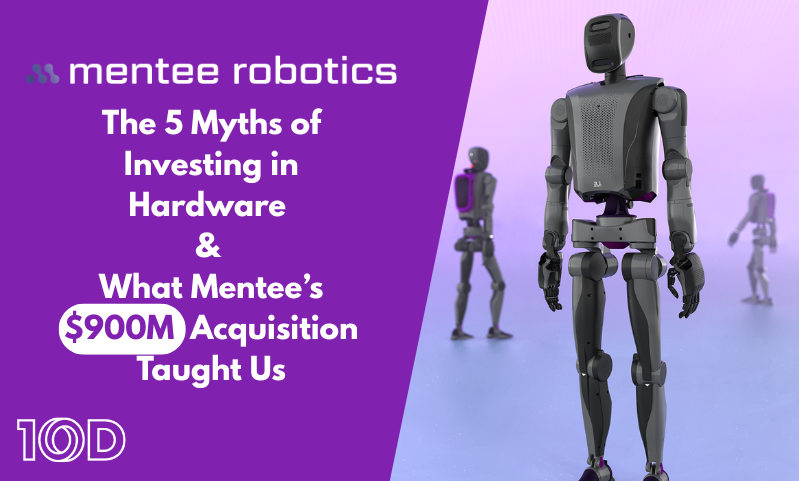
When we invested in Mentee, we heard all the familiar warnings:
“Hardware takes too long”
“Robotics is capital-intensive”
“Humanoids are science projects”
One year after Series A – and four years after founding – Mentee was acquired for $900M.
That outcome didn’t come from ignoring risk, it came from questioning a few assumptions that no longer fully hold. Here are five myths this journey helped clarify:
Myth #1: Hardware companies take 10-15 years to work
This used to be true when capability was gated by physical iteration.
But in AI-first robotics, the rate-limiter increasingly becomes the learning loop (data → training → deployment feedback), not the mechanical redesign cycle. Mentee’s tightly integrated hardware–software stack (LLMs + reinforcement learning + autonomy) was built so that capability could compound through software and training, not just by rebuilding the robot.
Myth #2: Robotics is too capital-intensive for venture outcomes
Robotics gets expensive when progress depends on physical iteration: more prototypes, more break/fix cycles, more edge cases discovered only after deployment.
Mentee was unusually capital efficient because it shifted much of that learning into virtual simulation. By training and stress-testing behaviors in high-fidelity simulation before real-world rollout, the loop moved from:
build → test → rebuild
to
simulate → train → deploy
This led to lower cost per learning cycle: faster iteration per dollar, fewer costly hardware resets, and the ability to reach commercial-grade capability with significantly less cumulative funding than many peers.
Myth #3: Humanoid robots are more vision than business reality
Most industrial environments are built for humans.
Mentee’s humanoid form factor was not a moonshot. It was a pragmatic choice to minimize integration friction and accelerate deployment in human-centric environments. General-purpose humanoids can cover a wider range of “in-between” tasks where single-purpose automation systems and robotic arms, without costly retrofitting.
In this case, choosing a humanoid wasn’t about ambition, it was about faster time to value and broader commercial applicability.
Myth #4: Israel isn’t the right place to build robotics companies
Israel may not be a manufacturing hub, but it excels at AI, autonomy, and complex systems engineering – the hardest and most defensible layers of modern robotics.
Mentee was built in Israel, with core R&D, autonomy, and system integration developed in-house. Rather than outsourcing complexity, the team focused on owning the most critical parts of the stack: learning, perception, and end-to-end autonomy.
Myth #5: Deep tech exits are rare and unpredictable
They are rare, but not accidental.
From early on, Mentee was built around defensible, strategically relevant layers of the stack, with clear value to OEMs, logistics operators, and tech incumbents building embodied AI roadmaps.
Deep tech becomes unpredictable when companies optimize for technology alone. It becomes far more legible when they optimize for who will ultimately care, and why.
The Bigger Takeaway
Mentee’s $900M acquisition doesn’t mean deep tech is easy.
It does suggest that some of the mental models used to dismiss robotics are outdated – shaped by a pre-AI era and very different market dynamics.
AI compresses timelines. Labor economics pull demand forward. And general-purpose robotics is moving from experimentation to deployment.
Sometimes the risk isn’t backing deep tech. Sometimes the risk is assuming it still behaves the way it did ten years ago.